As-of feature availability and revisions
Separate event, publication, received and corrected versions before building a causal model input.
An event timestamp is not an availability receipt
A field may describe an earlier event while becoming available after the model's decision. Announcements, revised fundamentals and completed bars illustrate different boundaries. Record the source event time and the time or step at which the allowed system could use that version. An earlier date printed in a revised table does not prove earlier access. A real feature contract must specify which clock controls inclusion, how missing or late values behave and which source revision is permitted. Sorting by event date cannot repair a future-informed join.
A revision creates an additional source object
Preserve original and corrected values with their separate availability boundaries. A later correction can improve a historical explanation while being forbidden in the earlier decision input. The model card should declare whether training reconstructs as-of vintages or uses another explicitly qualified research reference. Do not describe a latest-vintage reconstruction as causal live evidence without checking that difference. Source rights and identity remain relevant as well. A table copied between files does not establish permission, original availability or which version a subscriber actually received.
Joins need concrete examples
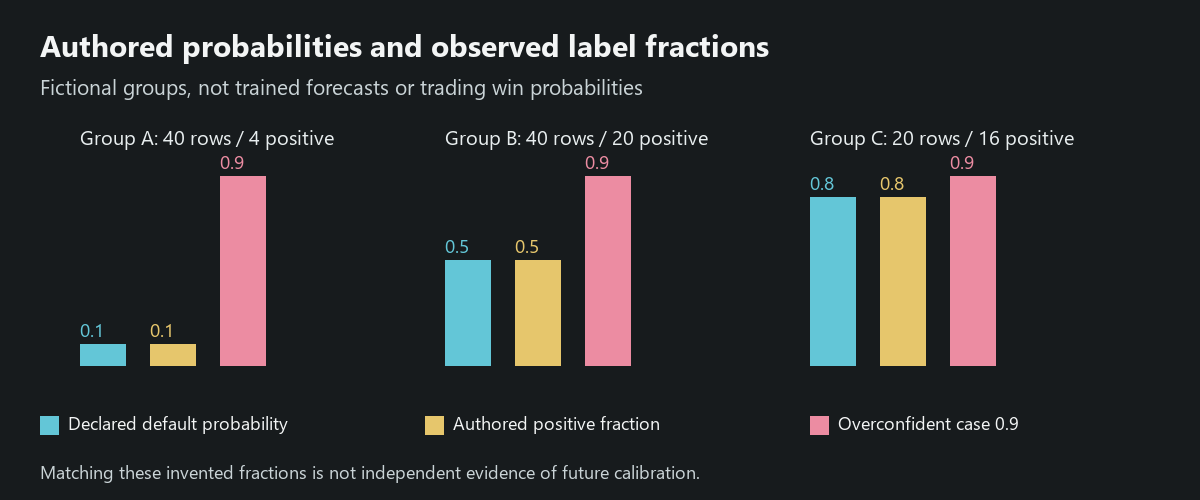
Trace one decision through its symbol or entity mapping, source lookup, transformation and target. Check that every joined field was permitted at the decision clock. A many-to-one join can duplicate events; a fallback can insert later values; a fill-forward can conceal a missing observation. Preserve an excluded or unresolved example so the join's failure branch remains inspectable. The probability CSV has authored group rows but no availability timestamps and cannot supply these receipts. Its arbitrary ordering is intentionally inappropriate as authentic chronological feature evidence.
Availability defects change the research conclusion
If a material feature cannot be reconstructed within the declared clock, the candidate's causal identity is unresolved. That is not automatically proof of intentional deception or a negative financial result. Report the boundary and its impact on which evaluation still applies. A revised input policy may require a new candidate rather than a silent historical repair. Keep raw entry ranking and subsequent chosen-exit validation distinct. The authoritative instrument method must determine actual completion; a passing join fixture or a plausible data-source explanation cannot replace its independently verified master.
Fictional model evidence case
The fictional classifier card has a decision at observation step 30. An event occurs at step 29 but its permitted source version arrives at step 31, so it is unavailable at the decision. A correction arriving at step 40 cannot be backfilled into step 30. These are authored indices, not measured vendor latency. The case says which version could be used, not whether a real model or data provider met a timing promise.
| Object | Record | Bounded finding |
|---|---|---|
| Event | Step 29 | Not an access receipt |
| Decision | Step 30 | Feature unavailable |
| Arrival | Step 31 | Too late for decision 30 |
| Correction | Step 40 | No retroactive insertion |
Primary references and scope
Source review: 14 October 2026. Official mechanism descriptions are not this desk's paid-account test, independently captured fills or vendor-return audit.