What Makes a Trading Model the Same Model?
Track features, data, labels, selection, exits and release identity so a research result cannot silently become a different live claim.
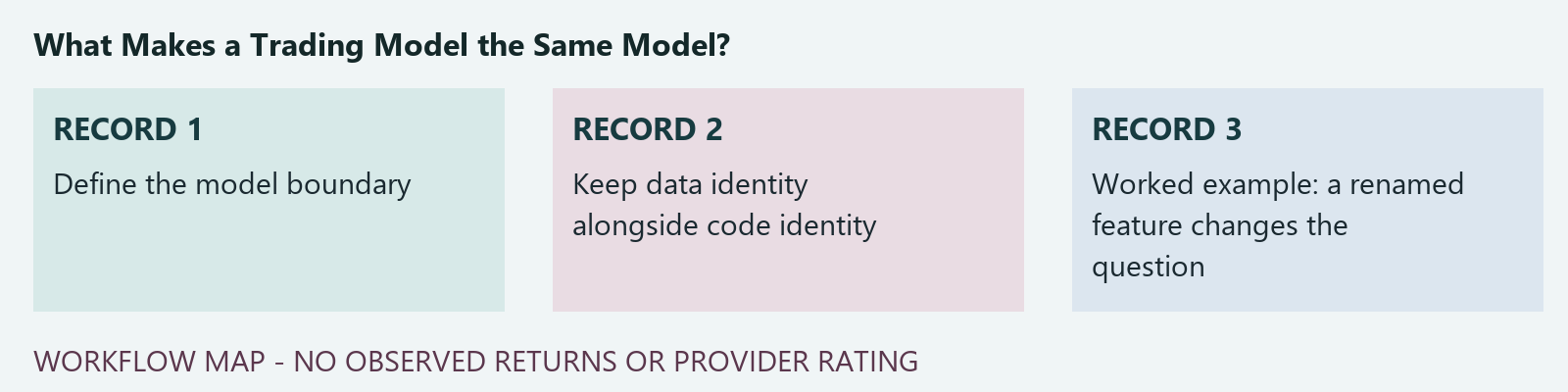
Define the model boundary
A model identity includes more than a name or saved weight file. Record instrument routing, feature definitions, data availability, transformations, label objective, fitting method and decision clock. Distinguish the entry model from execution, sizing and exit policies. A version can keep the same marketing label while changing a material component. The research record should make that change inspectable instead of allowing an old validation result to follow a different implementation simply because the displayed model name stayed familiar.
Keep data identity alongside code identity
Save source snapshot, coverage, revision policy, timezone and dependency versions. Re-running identical code against revised inputs can produce a different experiment. A file hash establishes byte identity, not that the data were available at the historical decision. Similarly, a code revision does not prove that the runtime deployed it. Keep research configuration, code state, registry or gate state, deployed revision and subscriber route separate. None should be inferred solely from a filename containing live or a successful local import.
Worked example: a renamed feature changes the question
Invent a model using the previous completed session's close. A refactor accidentally substitutes the current session's final close while keeping the feature column name unchanged. The script can run and the saved model can load, yet the historical decision now uses unavailable information. A schema test checking only the column name would miss the change. Require an availability-aware fixture and a feature-definition version. This example demonstrates identity and causality checks, not a finding about any actual deployed model or an investment result.
Freeze selection before later evidence
Declare the candidate family, search budget, objective and selection rule before evaluating later outcomes. Changes after inspecting the proposed holdout belong in a new candidate and access record. Cross-validation software can help organise folds, but it cannot decide whether labels overlap, an instrument universe is hindsight-selected or an external feature arrived late. Probability-calibration documentation also distinguishes prediction scores from validated probability interpretation; a model confidence label should not silently become a personalised position-size recommendation.
Version execution independently
Order translation, validity, exits, partial fills, costs and account controls can change the economic result without changing the entry predictions. Retain the policy version paired with each evaluation and each subscriber instruction. If an exit changes, do not preserve the old combined-performance claim as though only presentation changed. Keep hypothetical research references distinct from broker fills. A result can legitimately belong to one entry identity under one execution policy and remain untested under another.
Publish a release contract
A useful release record names the research artifact, code revision, selected configuration, paired execution policy, gate outcome, cloud deployment evidence and routed offer. State gaps explicitly rather than allowing one passed component test to imply end-to-end release certification. The blank identity worksheet is a documentation aid, not proof that a particular service satisfies these requirements. It prevents a common ambiguity: the word model can refer to a research candidate, a merged implementation or a live subscriber product, and those states require different evidence.
Decision record
| Question | Record to retain | Decision boundary |
|---|---|---|
| Research | Feature, label and selection identities | A familiar name does not preserve the experiment |
| Data | Snapshot, availability and revision policy | Byte identity is not historical availability |
| Execution | Paired exit, fill and cost version | Changed economics require a separate evaluated identity |
| Release | Gate, deployed revision and subscriber route | Code presence does not establish production state |
Blank working record
The worksheet contains column headings only. Enter your own dated observations, keep absent evidence marked unknown, and do not treat the file as certification.
 Download worksheet (CSV)
Primary references
- scikit-learn: cross-validation and temporal data
- scikit-learn: probability calibration
- NIST: Secure Hash Standard
These documents support mechanisms and source definitions, not a tested trading result or a recommendation. Accessed 9 October 2026. The decision workflow and invented examples above are editorial exercises.
Keep reading
Publication methodology | Working glossary | Source and correction policy
Keep probability generation in the identity
When a model outputs probabilities, preserve positive-label definition, transformation parameters, fitted estimator and any calibration layer before the threshold policy. A change to any material component requires an explicit compatibility decision. The group lens has no fitted estimator or calibration map: its probability inputs are declarations. Its output therefore cannot prove a real model's version identity. An immutable release document should link to the actual training and evaluation artifacts and separately to the cloud object that subscribers receive. A matching product name or passing page readback establishes neither financial validation nor unchanged input construction.