Skip to model research
Systematic Trading ModelsSpecification / Evaluation / Release

Systematic Model Release Workbench

Review a model as a versioned decision system: data identity, entry objective, exit ownership, reserved evaluation and durable operational state.

Your evidence states are not a provider score, audit opinion or performance finding.
0 documented10 unresolved0 not applicable

RECORD 01

Model identity

What immutable specification distinguishes this release? A filename or friendly model name cannot establish its training inputs, parameters and decision meaning.

Evidence: Release digest and specification

RECORD 02

Data contract

Which instruments, source versions and availability rules feed the model? A new dataset with the same columns can change the actual experiment.

Evidence: Input identity and source clock

RECORD 03

Entry objective

What raw causal objective selected the entry candidate? Later exit-adjusted profit must not quietly determine which entry version is presented as selected.

Evidence: Frozen entry criterion

RECORD 04

Exit attachment

Which single predeclared exit belongs to this evaluation? Reopening an exit tournament after accessing results adds unreported selection.

Evidence: Exit version and attachment decision

RECORD 05

Transformation scope

Which development observations own scaling and feature construction? Fitting transformations on future rows can leak information despite an earlier model fit.

Evidence: Transform code and fit window

RECORD 06

Reserved evidence

Which outputs were actually unseen before freezing the release? Repeated holdout access should stay in the record for every subsequent candidate.

Evidence: Evaluation period and access history

RECORD 07

Operational states

How are pending, open, partially exited and failed decisions represented? A return calculation does not define a recoverable execution state machine.

Evidence: State definitions and transition ownership

RECORD 08

Runtime ownership

Where does durable state persist if a personal computer is off? A local research script cannot be the only production scheduler or recovery source.

Evidence: Managed service and durable artifact

RECORD 09

Promotion evidence

Which independent checks and deployed artifacts support a release claim? Code presence, registry state and subscriber routing require separate evidence.

Evidence: Gate receipts, deployment and route

RECORD 10

Rollback contract

What version and persisted row ownership would a rollback restore? Replacing code alone may leave decisions owned by the newer policy.

Evidence: Rollback version and state reconciliation

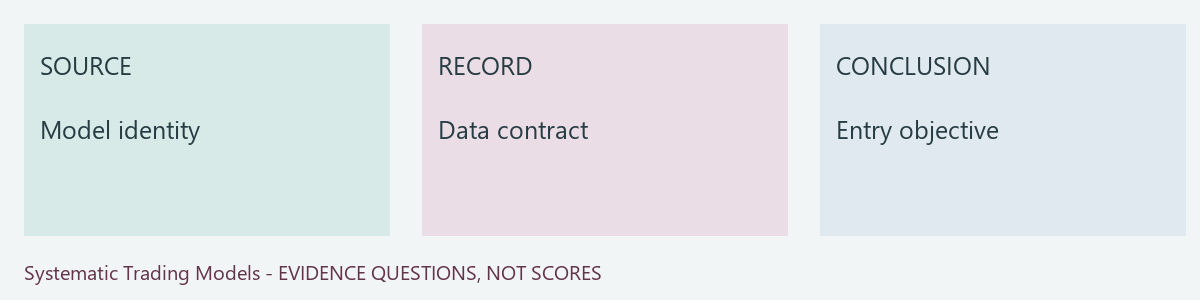
Original source, user evidence record and bounded conclusion
Different evidence objects, not a numerical quality ranking.

Primary reference documents

References support source definitions and mechanisms, not a completed review, measured return or endorsement. The questions are this publication's editorial record design.

What Makes a Trading Model the Same Model?

Model-card evidence before a release conclusion

Attach the identified entry objective, source availability, transformation scope, label ownership and independent master to the corresponding evidence fields. A clear card is a specification; only actual artifacts can document research completion. Manually selecting documented does not authenticate a source or make it independent. Imported records retain their own site and check identities to prevent mixing incompatible forms. Preserve a missing reference as unresolved rather than adding a placeholder URL that appears authoritative. The workbench is a reader's collection of evidence questions, not a financial certification engine.

A release chain must survive machine shutdown

Production data refreshes, publishers, schedulers and verification belong in managed cloud services. A local test or manual deployment is not an ongoing production dependency. An actual model release needs its cloud artifact and subscriber route distinct from a research LIVE label or source file present on a branch. This static site edition deploys no new model, creates no local scheduler and purchases no capacity. The browser workbench runs locally for the visitor because it is an educational form, not a production model pipeline.

Model-card and probability references